AI Sermon Summary: What It Is and How Far to Trust It
An AI sermon summary is a machine-written condensation of a sermon: software reads the full text of what a preacher said and hands back the main idea, the supporting points, the scriptures cited, and the takeaways. That much is simple. The questions behind the search are more interesting: how does it actually work, how good is it really, and does AI have any business being this close to a sermon at all? This page is the explainer, and it tries to answer all three honestly. If you already have a message in hand and just want the practical walkthrough, our sermon summary generator guide covers what goes in and what comes out.
What is an AI sermon summary?
It is not a transcript, which is the full text of everything said. And it is not your notes, which are whatever you managed to write at listening speed. An AI summary sits between the two: a short, ordered account of the message, produced by software from the complete transcript. Where your notes capture what struck you, the summary aims to capture what was preached, including the parts you were not writing down.
How does an AI sermon summary work?
Two steps. First, the audio becomes text: speech recognition turns the recording into a transcript. Second, a language model reads that transcript and produces the summary.
It is worth being plain about what the model is doing in that second step. It is not understanding the sermon the way you do. It is recognizing the shape of an argument in text, the same shape it has seen in enormous amounts of writing: a central claim, support, illustration, application. Sermons are well-structured speech, which is exactly what this kind of compression handles best. The model's one real advantage over a human listener is coverage. It reads minute thirty-eight with the same attention as minute five, because it was never busy writing down minute thirty-five.
How accurate is an AI sermon summary?
For the mechanical part of the job, condensing an hour of structured speech into its main points, current AI is genuinely good. But it fails in specific, predictable ways, and it is worth knowing them:
- It inherits transcript errors. The summary can only be as faithful as the text underneath it. Book names, chapter-and-verse references, and King James phrasing are exactly where general-purpose speech recognition stumbles, and a misheard reference flows straight through into the summary.
- It can flatten emphasis. A model may weight a vivid illustration as a main point, or miss that the whole message turned on one quiet aside. It summarizes the words, not the weight the preacher put behind them.
- It paraphrases. A summary states things in its own words, and its own words are sometimes close to the preacher's rather than identical. Before you repeat a line as something your pastor said, check it against the transcript.
- It only knows what was said. The prayer before the message, the pause that landed harder than any sentence, what was happening in the room: none of that reaches the transcript, so none of it reaches the summary.
None of this makes the summary useless. It makes it a map. A map is enormously useful, and nobody mistakes one for the territory.
Does AI belong anywhere near a sermon?
It is a fair question, and it deserves a straight answer rather than a sales pitch. Here is ours: AI can condense what was said. It cannot interpret Scripture, it does not sit under the authority of the text, and it has no stake in whether you were changed by the message or merely informed of its contents. A sermon is not only information transfer, and the part that is not information transfer is entirely outside what any summary, human or machine, can carry.
So the right category for an AI summary is the one that already holds the concordance, the printed outline in the bulletin, and the church's old tape ministry: aids to memory and study. Nobody thought the cassette recording replaced being in the room, and nobody should think a summary does either. If reading the summary becomes a way to skip sitting with the message, the tool is being used backwards. If it is the reason Sunday's message is still with you on Thursday, it is doing exactly what a good tool should.
When is an AI sermon summary actually useful?
In practice, a few situations come up again and again. Rereading the summary mid-week, before small group or just before the memory fades, is the most common one, and it works well alongside the habits in our guide on how to remember a sermon. Catching up on a service you missed, from the church's posted video, is another. And once you have months of messages saved, the summaries are what make that archive skimmable: you can find the sermon about forgiveness from last spring without replaying last spring.
How Sunday Notes AI approaches it
Sunday Notes AI builds its AI sermon summary from the full transcript of any message you record or import from a YouTube link. It returns the main points, the key verses, and the takeaways, so an hour of preaching becomes a one-minute read.
The limits above shaped how it works. Scripture detection checks every reference against a built-in KJV Bible, so the verses in your summary are real passages you can open and read, not paraphrases. And the summary is stored right next to the full transcript on your device, so the source is always one tap away when something matters enough to verify.
Get the app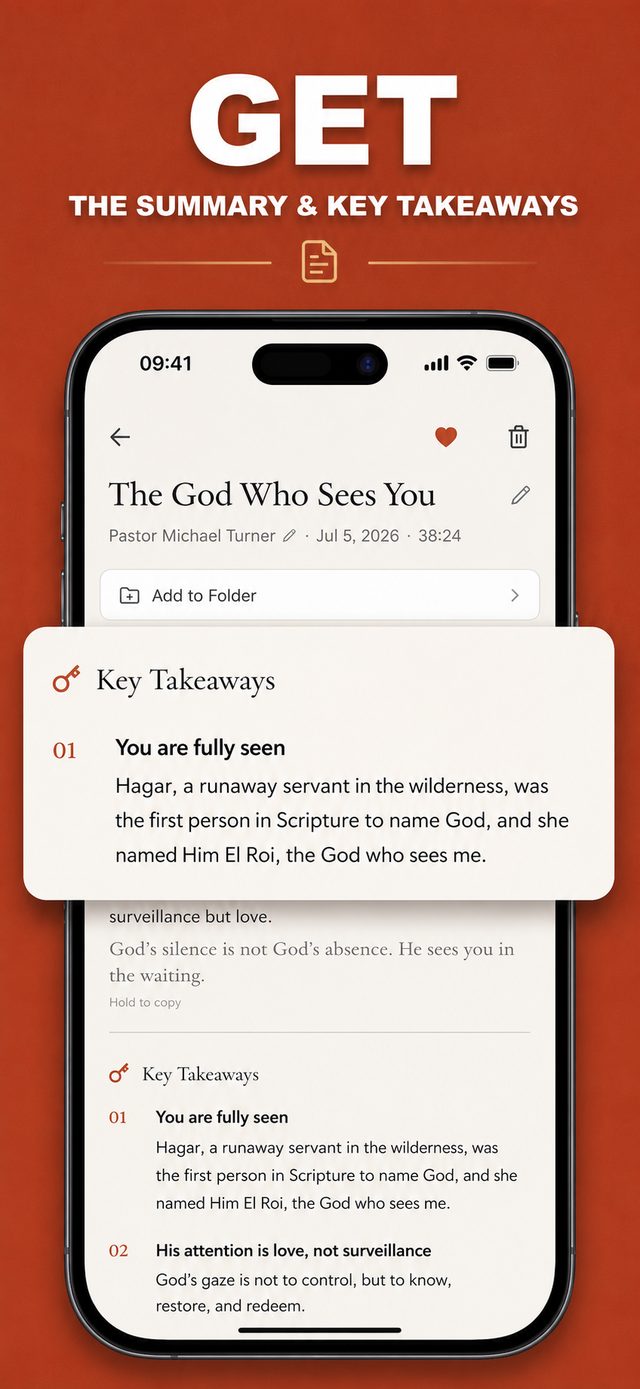
Common questions
How does AI summarize a sermon?
In two steps: speech recognition turns the recording into a transcript, then a language model reads the whole transcript and pulls out the structure a person would recognize, the central point, the supporting arguments, the verses, and the application. The result is a short, ordered summary rather than scattered sentences.
Is an AI sermon summary accurate?
Good at compression, fallible in known ways: it inherits transcript errors, it can misjudge emphasis, and it paraphrases. Treat it as a reliable map of the message, and go back to the transcript and the verses for anything you plan to quote or build on.
Can AI interpret the Bible?
No. It can condense what a preacher said about a passage, but interpretation, weighing Scripture against Scripture and applying it to a life, is not something a summary does. The verses remain the authority, and the summary should always point you back to them.
Does an AI summary replace listening to the sermon?
No, and it should not try. Its job is to help what you heard survive the week, not to stand in for hearing it. If it lets you skip sitting with the message, it is being used backwards.
Keep reading
The transcript is the foundation everything above sits on, and our guide to finding an app that transcribes sermons covers that step. Or head back to the Sunday Notes AI home page to see how the whole app fits together.