How to Take Notes During a Sermon
Learning how to take notes during a sermon is really about a tension: you want to write down what matters, but every second spent writing is a second you are not listening. Most people end up half present, scribbling a phrase while the pastor moves on to the point that would have changed their week. This guide gives you a simple, honest method for taking sermon notes that keeps your attention where it belongs, and shows how to remove the writing problem altogether.
Why is it so hard to take good notes in church?
The trouble with taking notes in church is timing. A preacher speaks around 130 words a minute. You can write maybe 20. So every note is a small bet: is this sentence worth looking down for, worth missing the next thing for? Make that bet a hundred times in forty minutes and you leave with a page of fragments and the nagging sense that the best part slipped by while your head was down.
There is also the memory side. Studies on how we forget go back to Hermann Ebbinghaus in the 1880s, and the pattern has held up: without review, most of what we hear is gone within a day or two. Notes are supposed to fight that, but only if they are good enough to bring the message back later. Fragments rarely do.
So the goal is not more notes. It is fewer, better notes, written in a way that costs you the least attention while the sermon is happening.
What is the best method for taking sermon notes?
The most reliable sermon-note method is the one you can repeat without thinking. Try three zones on the page. At the top, the main point in one sentence. In the middle, the verse references and one short phrase for each. At the bottom, a single application: one thing you will actually do this week.
Notice what this structure protects you from. You are not trying to copy the sermon. You are catching the skeleton so the muscle can come back later. When you reread it on Sunday night, the references pull up the verses, the phrases pull up the points, and the application keeps the whole thing from staying theoretical.
- Main point: one sentence, in your own words.
- Verses: the reference plus a three-word cue.
- Application: one concrete step for the week.
If you have used the Cornell method in school, this is its simpler cousin. Cornell splits the page into notes, cues, and a written summary you add afterward, and it works fine for sermons, but only if you actually sit down later and write the summary. The three-zone page survives real Sundays because it asks almost nothing of you in the pew, and the review step is small enough that you might actually do it.
Should you take sermon notes on paper or on your phone?
Paper has two quiet advantages in a church service. Nobody wonders whether you are texting, and nothing on the page can interrupt you. It also forces you to condense, because your hand is slow, and condensing is half of what makes a note stick.
A phone wins on everything that happens after Sunday. Typed notes are searchable, they do not live in a drawer, and your phone is with you when you want to reread on Tuesday. The cost is in the moment: one notification can pull you out of a sermon faster than any distraction paper can produce. If you type your notes, turn on do not disturb before the first song, not when you notice the problem.
Either choice works. What matters is deciding before the service starts, so the tool never becomes the thing you are thinking about.
Catch the references, not the wording
If you only do one thing differently, do this: write the verse reference the instant you hear it, before you write anything else. Verses are the part you can look up in full later, so a reference like Romans 8 verse 28 is worth ten times more than a paraphrase of what the pastor said about it.
This also lightens your hand. Instead of racing to transcribe a sentence, you jot four characters and look back up. Your eyes stay on the message, and nothing is really lost, because the reference will take you back to the full text any time you want it.
Review is the step almost everyone skips
Notes you never reopen are just a way of feeling productive while you forget. The single habit that changes everything is a short review within a day. Reread your page, fill in the gaps while your memory is still warm, and mark the one point you want to carry into the week.
This is where a recording quietly beats a handwritten page. If you have the full message captured, review is not a race against your fading memory. You can go back to the exact words weeks later, not just the fragments you managed to catch.
Step by step
Set your intent before the service
Decide what you are listening for: one truth, one verse, one action. A single focus keeps your notes from turning into a transcript you never read again.
Capture references first, thoughts second
Write down verse references and short phrases in the moment. Save your own reflections for the margins so you can keep listening.
Use a repeatable structure
Split the page into main point, supporting verses, and one application. The same shape every week makes past notes easy to scan.
Review within 24 hours
Reread and finish your notes on Sunday afternoon while the message is fresh. This is the step that turns notes into memory.
A hands-free way to take sermon notes
Sunday Notes AI removes the core problem: you no longer have to choose between listening and writing. You press record when the sermon starts and set the phone down. The app captures the whole message, so your attention can stay on the preacher instead of your pen.
Afterward you get a full transcript, every scripture reference detected and looked up, and an AI summary with key takeaways. If you still want to jot a personal thought, you can add your own notes to the sermon, but the heavy lifting is already done. Your best week of note taking is the one where you barely wrote anything at all.
Get the app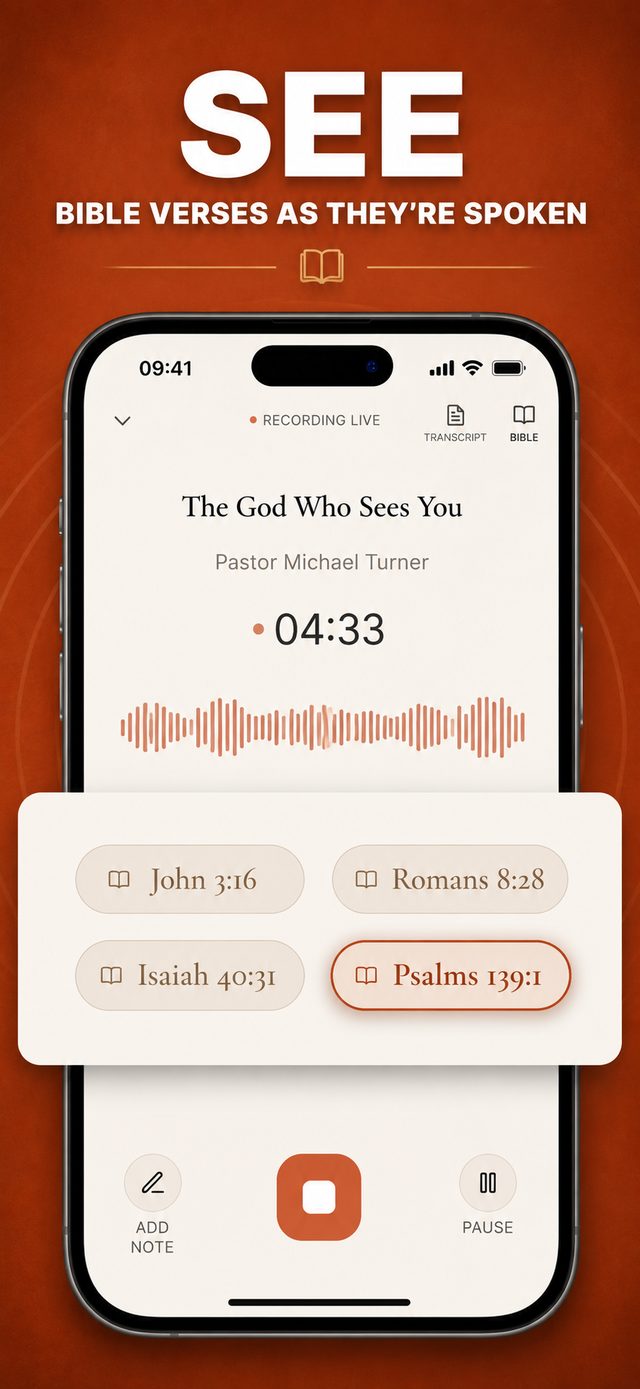
Common questions
Should I write in complete sentences?
No. Complete sentences take too long and pull your eyes off the message. Use short cues: a reference, a three-word phrase, one arrow. You can flesh them out during your Sunday review while the sermon is still fresh in your mind.
Is it better to type or handwrite sermon notes?
Handwriting tends to help memory because it forces you to condense as you go, while typing lets you transcribe without thinking. Either works if you keep notes short. The real gain comes from not writing much at all and capturing the message another way.
What if I miss a point while writing?
That is the built-in cost of note taking by hand, and it is exactly why capturing the full message with a recording helps. If the whole sermon is recorded, a point you missed in the moment is still there to recover later.
Keep reading
More guides that go with this one: how to remember a sermon, how to organize sermon notes, best way to record a sermon on iphone. Or head back to the Sunday Notes AI home page to see how the whole app fits together.